

As well as containing plot-spoilers, this piece will make better sense to those who have already seen Vertigo. If you haven’t, you should watch it before reading on. Unless you really have no interest in doing so. But you should, because it’s a masterpiece. And it’s not just me saying that. At least 3 other people have confirmed it.
On a hot summer hallucination, Vertigo carries you gently into its clammy nightmare where ghosts manifest as solid and Scottie’s spiralling obsession with a delusional woman is as inevitable as ours with one of the best films ever made.
I always knew colour had something to do with the film’s potent atmosphere, but it was only after 10 (or so) viewings that I began to understand just how well-designed its distinctive palette is and how cohesive it creeps with the themes and their narrative progression.
The colour that invades the eye as soon as you start paying the smallest attention to set and costume is GREEN.
 Early in the film it is a very particular light shade, a washy kind of mint green. It makes its mark first with the introduction of Madeleine as Scottie sits quietly watching her at a bar. The green shawl she wears with her black dress stands out among the greys and dark blues of everyone else in the scene. This establishes it as her colour.

This is affirmed the next day as Scottie tails her car to observe for himself the odd behaviour reported by Madeleine’s husband. The car is green, a less lurid shade, one that blends particularly well with foliage and shrubbery – something that takes on significance later.
After following her from a distance for some time, Scottie firsts meets Madeleine face-to-face after saving her from drowning in San Francisco bay. He takes her back to his apartment where she recovers. Right from this first encounter, Scottie is immediately enamoured. His clothes, his cushions and many fixtures around him are mint green. It’s not that he has somehow acquired all of these minty green objects as a way of becoming closer to Madeleine, the colours aren’t supposed to be a realistic representation of his apartment. It is more likely an impressionist (like the whole dreamy atmosphere of the film) way of showing how quickly Scottie has begun to fall for the ethereal woman. The seeds of his obsession are sown.

The red and white-dotted colours of Madeleine’s gown in this scene are also important to note.
 That’s because on the next day, when Madeleine ends up driving Scottie out to a forest, Scottie is wearing a red and white-dotted tie.His mimicking is difficult to write of as coincidence. What is more, Madeleine is the one driving. If any more evidence is needed to suggest Scottie’s irrevocable slide into obsession, it is his position on the passenger seat in Madeleine’s mint-green-furnished four-wheeled honey trap.
When they reach the forest, they muse over the giant redwood trees around them. Scottie explains: “their true name is Sequoia Sempervirens: always green, ever-living.” Madeleine responds: “I don’t like them… Knowing I have to die…”
With this dialogue (the only mention of the colour in the film) we are given a first idea as to what green might signify: life, specifically long, even eternal life. Madeleine’s problem is that she intermittently takes on the persona of Carlotta Valdes, a woman who killed herself many generations previously. Green could mean the reincarnation of this dead woman, a symbol of her curse, never being able to rest. Then again, Madeleine seems terrified of death – she is worried where the possession she suffers might lead her. So does she surround herself with green to ward it off? Or could it be a prelude to Madeleine’s ‘death’? Or the refusal of Scottie later to let his obsession die? There are plenty of possible interpretations along the ‘green as life’ line.
The other main line is, of course, green as jealousy. This comes to the fore in the second act of the film, after Madeleine’s ‘death’. When Scottie has recovered from his long grief, he discovers a girl who bears a close resemblance to Madeleine so he follows her to her hotel and insists his way into her life. She is Madeleine, or at least she played that part when Scottie knew her the first time round, but Scottie is as yet unaware of this. Her real name is Judy. She wears green like in her previous guise but the difference is striking and obvious. Whereas Madeleine’s greens were always weak and diluted, Judy’s green is strong and bold – it’s clear that she is the non-fictional woman.
However this is where Scottie’s obsession spirals out of control and, tragically, he sets about transforming Judy back into the Madeleine that never existed. His jealousy is squeamishly misogynist because he rejects the real woman. We, who have been behind him for an hour and a half as the protagonist, have to watch as he objectifies Judy as a kind of empty-headed doll and then, in an insatiable craving for a dead ideal, buys her clothes identical to Madeleine’s, bleaches her hair and forces her back into character. The culmination of this effort sees ‘Madeleine’ emerge from the pale translucent light of the Hotel sign outside into a solid form.

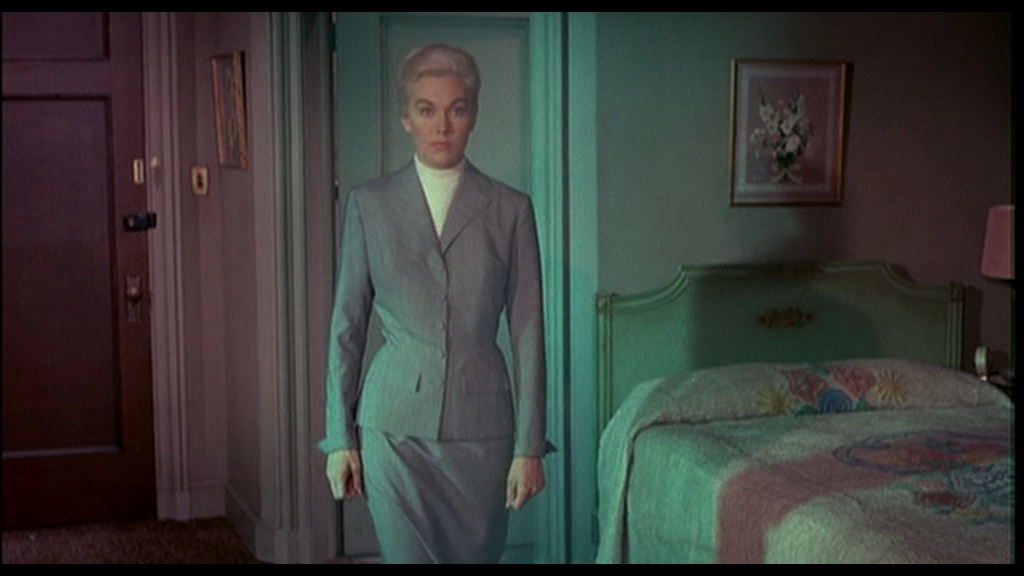
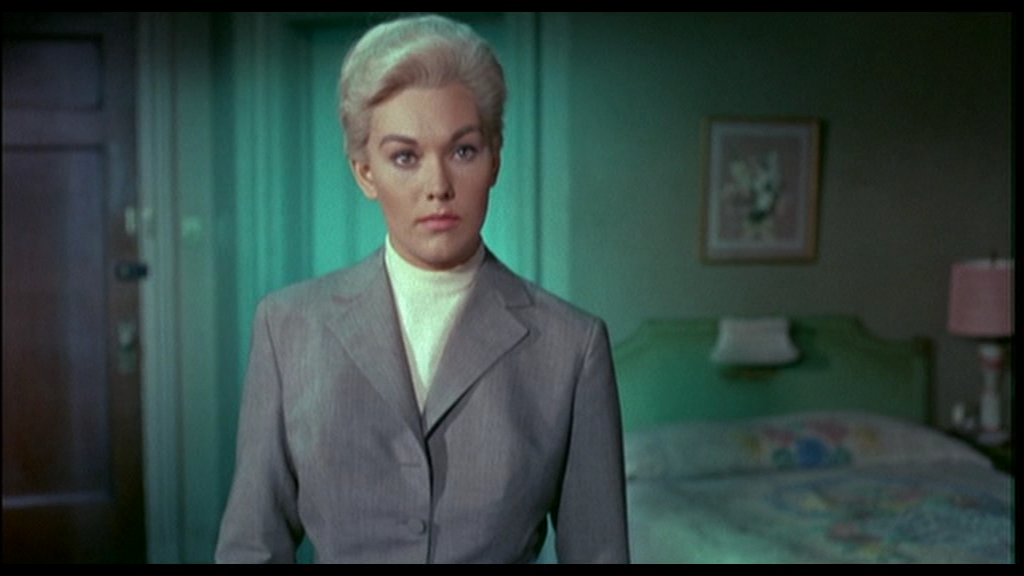
Crossing two themes, this moment demonstrates how Scottie’s envy and obsession has seemingly brought his love back from the dead. Despite the perfect cadence in the music, we know it is a sour resolution that can only end tragically. And it does in the final scene when the couple returns to the fateful bell tower and the haunting cycles of reincarnation are finally put to bed with an actual death.
 Jon Bates Writes