Robot & Frank (2013)

Robot & FrankIt’s rare that a film looks into ‘the near future’ and doesn’t see digital chaos, silicon tragedy and human slaves being electronically whipped by their robot overlords. Robot & Frank bypasses the technophobia of such films to present a far more recognisable version of our probable old age.

On the surface, Robot & Frank comes across as a gentle comedy about an elderly ex-jewel thief who is addled with a robot helper when his children stop visiting.

But it is neither as anodyne as this sounds nor as cynical as the sentimental tosh often lacquered with the ‘feel-good’ tag. It is gentle but unfolds with a real melancholy as the dementia of Frank (Frank Langella) is woven delicately with the perfection and pitfalls of computer memory.

Although initially rejecting the robot (I love that he never gives it a name), Frank eventually recognises its potential for assisting him in one last dip into his old criminal ways. The robot is the perfect friend for Frank, offering complete servility and confidentiality. Programmed to help Frank stay healthy, the robot also gives Frank the opportunity to fulfil his need to rebel – ironically, the more Frank disobeys its agenda, the more his youthful spark returns.

Robot & Frank & Liv TylerThe best thing about the film is its portrait of Frank. The robot may be Frank’s reliable rock but as it consistently reminds him, it doesn’t really exist as a tangible personality. The truth is, its main function is to allow Frank to become reacquainted with himself. Through his interaction with an infallible computer memory, Frank begins to recall long forgotten slivers of his life story – bittersweet both for him and us.

The film is a thoughtful meditation on ageing and delicately raises questions about the perceived burden of the aged, the failing human memory’s capacity for improvement and what benefits might be lost to both parties if the young abandon the old.

Stoker (2013)

Stoker - IndiaSo generally infantile are trailers in their desperate splurge of what distributors feel are the best moments of a film and so rife are they with conspicuous plot spoilers that I’m sold to any film that uses its minute-long advertising spot to give nothing away about what it might be about, what happens in it or even what genre it might be conveniently placed into.

See I hate trailers. I never post them. But this one is perfect.

Having watched Stoker, I remain somewhat unable to pigeonhole it. Psychological thriller? Dramatic horror? However best to comfortably describe it, the film holds up as one of the most affecting I’ve seen for many months.

Stoker - India and CharlieMia Waikowska plays India, an introverted teenager on the cusp of adulthood whose father has recently died in a car crash. Acutely aware of everything her 5 senses deliver and inherently suspicious of everybody around her, India lives with her troubled mother Evelyn (Nicole Kidman) in their isolated family home. When India’s estranged Uncle Charlie (Matthew Goode) introduces himself, she finds herself repelled and captivated in equal measure by her new relation as he aids her transition into adulthood.

Stoker is beautifully made, with a directorial touch as delicate as the central character’s super-tuned senses. The care taken in framing each subject is absolutely sublime and the pinpoint symbolism (keys, shoes, locked drawers, trees) is better than Hitchcockian.

Sound design is also very careful and close. Slow egg cracking, squeaking wine glasses and the amalgamation of a digging-spade with heavily played piano keys are about as good as it gets for a micro-sound junkie.

Stoker - EvelynThe trio of actors at the heart of the drama play their dysfunctional family with minimal… minimal drama actually, which really suits the piece because under each ice-cold exterior, you can see everyone is boiling. Uncle Charlie has a simmering malevolence, Evelyn is bubbling with grief and jealousy and India is brewing the potential of adulthood, never betraying quite in which direction she is blossoming until the final act.

I suppose you always realise a good film by how necessary everything you see and hear is to the effect it produces. Mysterious gestures, fastidiously-designed montages and complicated sound processes can all seem very gimmicky when used as a smokescreen to deceive audiences by glossing over a film’s shortcomings. But in a film such as this, where every carefully realised element is integral to its nature, the effect is simply stunning.

Maybe I’ve just had too many underwhelming experiences in the cinema of late but when a film completely traverses the alienation of a huge silver screen, beguiles you into its odd little world and then horrifies your sensibilities to the point where it still cloys at your mind 10 days after seeing it – well, that’s something to celebrate.

February Catch-up Part 2: Beautiful Creatures & I Give It a Year

Beautiful Creatures

Beautiful CreaturesWith the Twilight Saga done and dusted there is understandably a desperate clamouring by the major film studios to find the next supernatural literary phenomenon to adapt into a moody romance and thereby hopefully take the world’s teens for millions and millions of dollars. While cynical producers may have chosen Beautiful Creatures to adapt with this in mind, thankfully it seems to have been made by people with a little more humour and humanity.

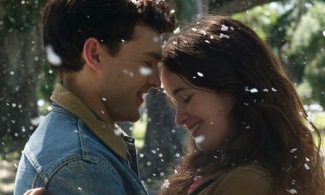
Ethan Wate (Alden Ehrenreich) is a big dreamer in a small-dreaming town in the deep south of America. When gothic misfit Lena Duchannes (Alice Englert) turns up at school and the other students start to gossip, we find ourselves immediately in familiar Twilight territory, just with the genders reversed.

Turns out Lena is a fledgling witch whose big issue is that her undeveloped powers will be claimed for either good or evil on her sixteenth birthday depending on her true nature. Trouble is, like all 15-year-olds, she has no idea what her true nature is. Her uncle, Macon Ravenwood (Jeremy Irons) is adamant she will be a force for good. As she and Ethan become close, the dark side of Lena’s family show up including her mother Sarafine (played like a force of nature by Emma Thompson) to complicate matters further.

Comparisons to Twilight are exhaustive: the romance between a human and a supernatural being, the supernatural as metaphor for teen troubles and the humans vs. ‘monsters’ dichotomy are all well-trodden themes – even the moody weather of its towns gives the light of both films a similar tone. Despite Beautiful Creatures using its predecessor as a template, the main distinction to be drawn is that this film has more of a sense of humour, less of an anti-sex subtext and generally a more down-to-earth feel than that of Twilight.

This works both for and against it.

The couple at the centre of the film are very likeable and drawn with a streak of self-awareness of the ludicrousness of their story’s supernatural themes. This helps them to never descend into the kind of stern self-torture of the straight-faced vampire fable. While this lends a better believability to their relationship, it waters down the power of its bond somewhat. Like it or not, although the life or death love of the Bella and Edwards of the genre seem sometimes like a melodramatic lie, I think teenagers recognise the desperate cling of first love best when the stakes are high. Adults may understand that Ethan and Lena are a better rounded couple but I think a younger audience are slightly less interested. This may already be showing in Beautiful Creatures box office figures, which – unfortunately – are nowhere near that of the first Twilight film.

I wouldn’t go so far as to say that the film is tongue-in-cheek. Both Emma Thompson and Jeremy Irons establish the good vs. evil battle with their weighty presences and no character or funny one-liner ever invites you to make fun of Lena’s predicament. It just isn’t as gripping as a film like this needs to be. It is easy to mock the young for being frivolous but however fleeting it may be, regarding idealised love, they are deadly serious. And this film isn’t deadly serious.

I can see why middle-aged reviewers warm to Beautiful Creatures more than other coming-of-age teen fantasies and, me now being the adult side of the dividing line, I’d sooner watch it again than another Twilight. But I suspect we aren’t the demographic being targeted here. For what it wants to achieve, Beautiful Creatures is fated as a well-meant misfire and I’d be surprised if the next book makes it to the big screen.

I Give It a Year

i give it a yearSecond-guessing the ending of this film almost confused me into thinking it had something new to add to the romantic comedy genre instead of actually having nothing new to add to the romantic comedy genre. Will newly married Josh (Rafe Spall) and Nat (Rose Byrne) make it past a year of marriage or will their obvious differences and attraction to the other people in their lives tear their relationship apart?

I definitely know that I want them to divorce, if only on principle (because the film never beguiled me into truly caring); they’re so ill suited that they pretty much hit the rocks the moment they tie the knot. But if the film starts this way, will it move to resolution by the end? Will they sort out their differences? Probably. We’re all used to romcoms convincing unhappy people that their unhappy relationships are worth the crushing disappointment for some deeply buried sliver of ‘love’. But then again as other love interests are introduced and the couple drift further and further apart, I’m being turned again. Is the most subversive and interesting outcome that they do in fact somehow stay together despite belonging apart?

All of this spun me into the most bewildering mind slush that I convinced myself I could be happy if only the outcome of this quandary was to my satisfaction. And when it ended right, I left the cinema with such a sense of resolution that it was only on the way home that I realised I’d been tricked.

I think the reason my brain turned I Give It a Year’s narrative into an epic twisting rollercoaster is because nothing on screen really occupied my attention. It meanders awfully, giving the impression of several improvised vignettes with no strands pointing in any particular direction. As I guessed from the cast list, the funniest turns were given by Stephen Merchant and Tim Key, but even these moments were too ill disciplined to squeeze anything more than smile and seemed isolated from all other scenes as if belonging in a completely different movie.

I’d been away from these kinds of films for so long that I forgot how placid the lighting is. All angles are covered, no shadow is allowed, the whole toolkit of cinematography is rendered utterly anodyne by the bright bright bright.

On a positive note, the characters themselves are likeable, individually. It’s just that there’s no pairing for an audience to root for – no two people that seem to click. Also praiseworthy is Anna Faris who is handed the best-drawn character I’ve ever seen her play. Even if she is a side note, Chloe is certainly the most interesting and warm in the whole film and Faris hits exactly the right note. If we’re rooting for anyone, it’s her.

Overall, I Give It a Year provides no emotional ride to jump on. But on the plus side, it’s sometimes so vacuous that you might find yourself inventing all manner of plot twist dilemmas with which to fill up the time.

February Catch-up Part 1: Zero Dark Thirty & Wreck-It Ralph

Zero Dark Thirty

Zero Dark ThirtyFor anyone but the most bloodthirsty American, the filling in of the minor intricacies in the last chapter of the War on Terror is the main attraction of this film. Watching it is an easy way to get better acquainted with the who’s who and (more importantly) who’s where of America’s Most Wanted list 2001-2011.

Which is handy. When bin Laden was killed I didn’t look into it too much, so watching Zero Dark Thirty served as a recent history lesson – which I think is how many will experience it.

I didn’t engage too strongly with Jessica Chastain’s Maya character and her struggle to be taken seriously by her CIA colleagues who are convinced she is pursuing a dead trail. Her triumph in convincing the men around her to follow the lead that eventually takes them to bin Laden seems inconsequential. If the film wants us to experience it as a feminist victory (at times it pushes this agenda but overall seems largely unsure) then it fails, if only because we all know that the highly classified nature of America’s intelligence organisations mean that the real life characters involved in ‘Operation Neptune Spear’ won’t enter public knowledge for many decades yet.

But I don’t mind too much that it fails on that level. No fictional CIA agent’s ‘personal journey’ can ever be as juicy as the actual storming of bin Laden’s compound, which Kathryn Bigelow directs with superb pacing. I caught myself with my mouth open as the helicopters reach their destination and the Navy SEALs silently rope down to the floor.

The odd thing about this film is that it’s worth seeing despite the fact that it fails to accomplish the emotional drama it sets out to fictionalise. The fast talking military speak and leaps of faith on ropey intelligence are the exciting thing – that’s why it is a good film, not because of any heart wrenching backstory.


Wreck-It Ralph

Wreck It RalpA successful modern Disney film finds new ways of presenting a familiar story. It succeeds on its surface freshness despite the underlying pedalling of proven ideas. This is not a criticism; a fresh look goes a long way in a surface medium and I am pleased to report that Wreck-It Ralph is indeed a successful modern Disney film.

Big studios learn what works from the wild failures and unexpected triumphs of more experimental fare. Wreck-It Ralph certainly has its foundations in other places. It’s central conceit of video game characters carrying on independent lives outside of human company has more than an echo of the Toy Story about it. The big heart of a designated bad guy also borrows from Shrek. Finally, the whole gamer style owes as much to the aesthetic of Scott Pilgrim vs. the World as anything else.

The story follows Wreck-It Ralph (John C. Reilly), the stuff-smashing nemesis of Fix-it Felix, Jr., whose 30 years of watching everyone rooting for the game’s hero Felix, has him try to turn the tables and win a medal for himself at long last. Eventually ending up in the game Sugar Rush, Ralph befriends another ostracised character, the glitching Vanellope Von Schweetz, and realises that helping secure his new friend’s victory in her kart-racing game (and so secure her very existence) is perhaps a nobler pursuit.

The voice acting is the best thing about the film. John C. Reilly has complained of being consistently typecast in the role of a man-child and Wreck-It Ralph offers him the chance to almost parody himself, playing the man-child card to the max. The difference here is that his character isn’t written for the audience to poke fun at for a change; his vulnerability is central to the role. Ralph is a powerful physical presence with the simple desire to be accepted and Reilly is perfect at giving voice to this innocent agenda. Sarah Silverman is excellent too; she lends a real sparky zaniness to Vanellope whose strong individuality yet sensitivity to Ralph’s plight really rings true.

The gaming style of the film’s look is fresh like I said and it’s no problem to accept the invitation to dive into it’s world, although I think it could actually have played up a lot more to the retro gaming theme. I might be too much the Scott Pilgrim fan but it borrowed an awful lot from that film’s aesthetic without doing the whole arcade game homage thing half as well. The pixelated Disney ident before the film begins isn’t as brilliantly brash as the 32-bit Universal ident it ripped off from Scott Pilgrim and its flashing “Press Start” text at the film’s close seemed tokenistic and didn’t tie in with the film’s story as perfectly as the Scott Pilgrim “Continue? 10…9…8…etc” ending.

Nevertheless, Wreck-It Ralph is good fun, feels shiny and original (even if it isn’t quite) and has enough of a strong narrative to carry it through. Kids probably love it – (I’ve no idea, don’t know any.)

Flight (2013)

Whip WhitakerFor a director celebrated for his groundbreaking special effects work, Flight is a confident and accomplished return to live-action filmmaking for Robert Zemeckis. The film is a character study of genius pilot Whip Whitaker (Denzel Washington) who saves the lives of nearly every passenger on board when his plane encounters a catastrophic failure mid-flight. Forced into rolling the aircraft upside down to stabilise an uncontrollable nosedive, Whip escapes the crash landing with minor injuries and is branded a hero by the adoring public. What they are unaware of is Whip’s toxicology report which reveals him to have been heavily drunk and under the influence of cocaine while flying the plane.

Directed very simply (mid-shots all the way), Zemeckis’ camera is quiet and unobtrusive, allowing the actors to play the drama through without too much stylish trickery. Despite this, he delivers the special effects-laden plane crash sequence with as much gusto as you’d expect. It is, up to now, the most gripping I’ve seen and will do nothing to soften my only recurring anxiety dream.

Main man Denzel Washington is superb. He gives the impression of a highly skilled professional convinced he can hide his alcoholism with his genius (even to his own eyes) – a subtle trick. He isn’t likeable but, due to the performance, we understand his disease and struggle with him all the way. (The groans around me as Whip slips again and again into drunkenness were nearly loud enough even to drown out the screening’s ubiquitous popcorn rustle.)

My one main problem with Flight was strangely its most enjoyable element – I’m talking about Whip’s drug dealer, played by John Goodman who seems so alien and removed from the stern drama that his presence threatens to twist it upside down into a completely different film. It argues with the overall preachy tone of the film. I never enjoy being preached to, but at least if you’re a preachy film, don’t dish out the light relief fun drug thing at the same time to punctuate the lecture in an attempt to make it palatable. Every time the pony-tailed dealer shows up, The Rolling Stones let loose in the soundtrack and Goodman delivers enough good jokes to conflict with the film’s message.

harling-mays-flight

It might work if it wasn’t for the soundtrack and the camera language (the only stylish touches Zemeckis adds are crash zoom cocaine rushes and rack focus on a heroin needle) which back Goodman up. It is as if the film is saying “Drugs are ruining this man’s life. Also, here’s a bit where we’re going all Fear and Loathing in Las Vegas with non-judgemental, light-hearted, some-people-have-a-good-time-on drugs segments… But seriously though, drugs are bad… But actually look at John Goodman here, isn’t he funny?… But SERIOUSLY, addiction=bad.”

The reason it jarred so strongly with me is that, while I appreciate the pacing, the struggle, the drama of Flight, Goodman’s interjections reminded me that the film I’d kind of rather be watching would be the one where his character was the lead. The writers don’t help themselves with this character, or maybe they simply didn’t count on Goodman doing such a good job.

Flight-Whip-and-NicoleThe scene where writer John Gatins really does shine is for me the standout moment of the film: Whips first meeting with Nicole (Kelly Reilly) on the hospital’s stairwell. He is recovering from a plane crash, she is recovering from a heroin overdose and in trundles the character named in the script as “Gaunt Young Man” who is most definitely not recovering from terminal cancer. The ensuing conversation is paced brilliantly, and the perspective offered from the Gaunt Young Man who is both upbeat and resigned to his fate is the catalyst for Whip and Nicole to try to make a life recovering together.

Ultimately, Flight is a Hollywood film and certain ideologies have to be maintained, events must have their consequences and ruined lives must be redeemed. These aren’t plot spoilers; from the moment Whip wakes up in hospital after the crash, we all know how the story is going to shake out. But the film knows we know and the important thing is how engaged we are from A to B. Thankfully the answer is: quite engaged. Invested enough to recommend it as a good watch, which is what I’m doing now.

Django Unchained (2013)

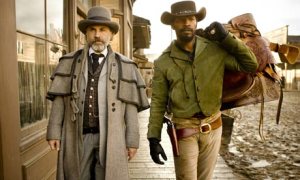
Schultz and DjangoQuentin Tarantino’s return to form is, like all of his best work, a showcase of tributes to his favourite exploitation films all squished together to the point of bloodbath. The outrageous violence of its set pieces is choreographed to perfection and is topped only by the mellifluous ear candy of the movie’s dialogue.
Let’s first be clear, there is no controversy here. Django Unchained is neither as offensive as Spike Lee imagines it would be (were he to actually give it a watch) nor is it as thought provoking as Tarantino himself pretends. The subject of slavery is volatile of course and a filmmaker who really wanted to ‘raise issues’ would have to tread extremely carefully. But this isn’t a film about slavery by Quentin Tarantino, it is a Tarantino film with some slaves in it.

The cast is nothing short of superb. Christoph Waltz was made to deliver the magniloquent exactitude of Tarantino’s dialogue and does it in a dandyish devil-may-care manner that never contradicts the menace of his character, Dr. King Schultz – a German ex-dentist bounty hunter who abhors slavery and sets Django free. Django himself is played by Jamie Foxx in a brooding and controlled manner which perfectly compliments his co-star. As the film progresses, Schultz betrays a burden of care for Django, who becomes more and more cocky as he adjusts to freedom. The interaction between the two as their performances shift is fascinating to watch.

Candie - Django UnchainedAlso fascinating is Calvin Candie, owner of the infamous Candieland plantation, who Leonardo DiCaprio portrays with a subcutaneous threat to match that of Schultz. The tension in the air as Django and Schultz slowly acquaint themselves with Candie is delightful. Under the guise of Mandingo Trainers (‘mandingos’ are slaves bred to fight each other to the death) they attempt to rescue Django’s wife, Broomhilda (Kerry Washington) from Candieland with a predictably messy climactic outcome.

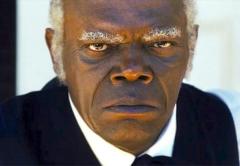
The ultimate show-stealer is Samuel L. Jackson who plays the elderly servant Stephen, Candie’s (sort of) Head of the House Slaves. Stephen is a masterpiece of a character, unconditionally loyal to his master but exhibiting the cheek of Django and the irritability of an old man who Candie has allowed to get away with years of surliness for the sheer fun of his outbursts. Jackson brings an unsettling elderly shake to his character and the slow-spreading contortions of face as Stephen becomes suspicious of Candie’s guests is physical acting at its finest.

If there is one element of the film that can be written about seriously in terms of racial politics then it is Stephen, it is the psychology of a man enthralled by his master, a man who truly believes himself inferior to a white man.

stephen-Django Unchained

Django Unchained is directed with the care and consideration taken to framing its subjects that the old Spaghetti Westerns took. Apart for the sequences of violence, camera movement is generally slow and often holds on shots that could pass as paintings as far as mise en scène goes – moments such as: the chain gang far off in the distance bookended by two nearby rocks at the screen’s left/right extremities, two horsemen riding as shadows into the sunset, a whole town pointing 100 shot guns at the camera and DiCaprio’s Candie grinning full-screen with smoke seeping through his teeth. Juxtaposed with this style is the occasional crash zoom, which nods fondly to old westerns, and induced grins around the cinema.


tarantino - djangoThe one gripe I have with the film is its lack of discipline. Quentin Tarantino is an auteur; of that there is no doubt. Give him a camera and some money and he’ll have a ball. But while that might be unbridled joy for him, his films suffer if nobody reins him in. Take his interviews in which he often makes fantastic points and examines cinematic issues in very interesting detail but which can quickly topple into ridiculous self-important ramblings if the interviewer lacks the bravery and awareness to contain his answers and switch the area of conversation when required.

My favourite thing about Tarantino is those absurd moments where captious characters tie themselves up in semantics trying to explain why a Ku Klux Klan mask isn’t practical when riding a horse or pondering the layers of meaning behind a foot massage. However, these can only work within the context of a story moving forward. Occasionally, Django Unchained loses its momentum. Whether this is because Tarantino is missing the skills of his late long-time editor Sally Menke or because he works best with a writing partner, I don’t know but it definitely looks as if the critical eyes of sterner collaborators could be vital in helping maintain the focus of his work as he moves into the later stages of his career.