The Hunger Games (2012)

In a dystopian future society where the rich live luxuriously in ‘The Capitol’ and the poor are divided into exclusive districts and forced to live feudally, 24 children are chosen at random every year and let loose in an enclosed arena where they are cajoled into mortal combat until only one remains. Based on a novel for young adults written by Suzanne Collins, The Hunger Games follows sixteen-year-old Katniss Everdeen who is selected to compete in the 74th of these annual televised contests.

By far the most gratifying thing about this film doing so well at the box office is the sheer number of people that are coming into contact with a narrative that throws light on the ugly side of current social phenomena and illustrates clearly and simply how hegemony works.

Like the best dystopias, Panem – where The Hunger Games is set – has carefully designed hierarchical structures which are maintained with a delicate balancing act. Demonstrating the clockwork involved in the working of a fictional society and having an emotional character-based drama unfolding at the same time is the author’s own balancing act. In fact, as long as neither overpowers the other, each inextricably boosts the effect of the other. For example, we can’t be moved to concern by Katniss’ plight if we don’t know how trammelled by violent controlling measures she and her fellow poverty-stricken district-dwellers are. Equally, we can’t be expected to get our head around the intricate details of Panem unless we see how its system shapes the life of a human being living at its centre.

The targets of Collins’ barbed satire are entwined in a tight cluster which probably contains as many of the viewers’ interpretations as the author’s own intentions. Those that seem most clear however revolve around reality TV, particularly reality TV as a means of spellbinding large swathes of populations into becoming obsessed with false narratives and a false hope of escaping a life of drudgery, thereby ironically easing the pressure of a life of drudgery, leading to an extension of the drudge itself. Also explored is the widespread cultural sentimentality that results from said false narratives, and how it begins to seep into real life.

The desensitising effect that this sick-sweet sentimentality leads to is of particular importance to The Hunger Games, specifically an indifference to violence, ‘The Games’ itself being a competition in which children kill each other.

The viewers of the contest are the wealthy minority who live within the capitol and bet with glee on the eventual winner. The costume design and palette of The Capitol’s citizens contribute magnificently to the idea of ‘the spectacle’ (ps. Read this if you want, yes, all of it) that encompasses their lives. Their lurid face paint and extravagant dress is ridiculous and terrifying in equal measure; the same could be said for their exploitation of children, with the emphasis on the terrifying.

All of this probably applies to the novel too, I wouldn’t know, haven’t read it, will now. My point is, the narrative is solid and, as Collins herself co-wrote the screenplay, the film tells her story well. With the most important thing taken care of, the only hurdles that could possibly hinder its success are exclusively down to the makers’ cinematic skill – how it is shot, how it is acted, how it is paced, how it is scored.

And most importantly: how it is edited. Because thankfully, everything else works nicely – particularly the acting (Jennifer Lawrence does a very good job). It is the editing that lets it down in my opinion – and I’d rather call it censorship. That is because, for a film that relies on a brutal and violent situation to engage and appal us, The Hunger Games is remarkably devoid of violence. In fact I don’t recall seeing a single drop of blood from start to finish. Was this a clever self-referential comment on the theme? Were we intentionally shielded from gore to stop us reacting in a human way, so that maybe we might see how anesthetised we already are to violence? To warn us how close we are to becoming like The Capitol’s citizens ourselves?

Well apparently not. Because while the version shown in British cinemas is fairly anodyne, this was not always the case. The original cut of the film submitted for classification was given a ‘15’ rating. Eager for it to be able to reach as large an audience as possible, the studio asked for advice from the BBFC on what changes could be made to downgrade it to a ‘12a’ rating. This included shortening the length of some particularly violent shots and digitally removing blood splashes from wounds and weapons.

So this is not the typical censorship we hear about where a single-minded director has their vision undermined by a country’s film board snipping out the bits it considers too nasty for its citizens. This is the makers and distributors of a film actively self-censoring their own work for marketing purposes.

But is there a less cynical motivation behind the cut? The original novel has been demonstrably popular with older children/young teens, with many of its readers falling between the ages of 11 and 14. It could be argued then that the self-censorship isn’t money-grubbing but actually makes the film available for the audience that enjoyed the book.

I suppose that makes some sense but the problem for me was that I wanted the shock and horror to really hit home. I wanted the promise of the little chill that ran through me when I first heard the film’s synopsis to be fully delivered. And the fact that a more brutal version exists and is shown in other countries is a bit of a let down.

Of course I understand the idea that cutting away before actual physical savagery can be more psychologically terrifying than not doing so. Memorably, the oft-referenced Psycho shower scene has plenty of shots showing the fatal knife thrusts but none of actual contact with the victim’s skin. I just don’t think such an approach works for The Hunger Games and it isn’t supposed to either, as the existence of the original cut testifies to. When the most important things about a social satire are child cruelty and a failure to react negatively to child cruelty, it seems obvious that we need to be given a chance to abhor such a numb society by seeing clearly on our silver screens what The Capitol’s citizens see on their TV screens. I would argue that the young teenagers who can handle the book won’t be too traumatised by a more explicit film. So why not keep the blood and let the 12-year-olds sneak in, as they always do anyway? Either that or have showings of the uncut version late at night.

All of this is just a small detraction from what is essentially a good film, especially as it updates the dystopia genre for the digital age and might well lead new people to works such as Brazil or Nineteen Eighty-Four. Every generation needs to be served a lucid vision of a society it is at risk of sleepwalking into and, for 2012, The Hunger Games will do nicely enough.

Vertigo (1958): Green! is the Colour. Green!

As well as containing plot-spoilers, this piece will make better sense to those who have already seen Vertigo. If you haven’t, you should watch it before reading on. Unless you really have no interest in doing so. But you should, because it’s a masterpiece. And it’s not just me saying that. At least 3 other people have confirmed it.


On a hot summer hallucination, Vertigo carries you gently into its clammy nightmare where ghosts manifest as solid and Scottie’s spiralling obsession with a delusional woman is as inevitable as ours with one of the best films ever made.

I always knew colour had something to do with the film’s potent atmosphere, but it was only after 10 (or so) viewings that I began to understand just how well-designed its distinctive palette is and how cohesive it creeps with the themes and their narrative progression.

The colour that invades the eye as soon as you start paying the smallest attention to set and costume is GREEN.

Early in the film it is a very particular light shade, a washy kind of mint green. It makes its mark first with the introduction of Madeleine as Scottie sits quietly watching her at a bar. The green shawl she wears with her black dress stands out among the greys and dark blues of everyone else in the scene. This establishes it as her colour.

This is affirmed the next day as Scottie tails her car to observe for himself the odd behaviour reported by Madeleine’s husband. The car is green, a less lurid shade, one that blends particularly well with foliage and shrubbery – something that takes on significance later.

After following her from a distance for some time, Scottie firsts meets Madeleine face-to-face after saving her from drowning in San Francisco bay. He takes her back to his apartment where she recovers. Right from this first encounter, Scottie is immediately enamoured. His clothes, his cushions and many fixtures around him are mint green. It’s not that he has somehow acquired all of these minty green objects as a way of becoming closer to Madeleine, the colours aren’t supposed to be a realistic representation of his apartment. It is more likely an impressionist (like the whole dreamy atmosphere of the film) way of showing how quickly Scottie has begun to fall for the ethereal woman. The seeds of his obsession are sown.

The red and white-dotted colours of Madeleine’s gown in this scene are also important to note.

That’s because on the next day, when Madeleine ends up driving Scottie out to a forest, Scottie is wearing a red and white-dotted tie.His mimicking is difficult to write of as coincidence. What is more, Madeleine is the one driving. If any more evidence is needed to suggest Scottie’s irrevocable slide into obsession, it is his position on the passenger seat in Madeleine’s mint-green-furnished four-wheeled honey trap.

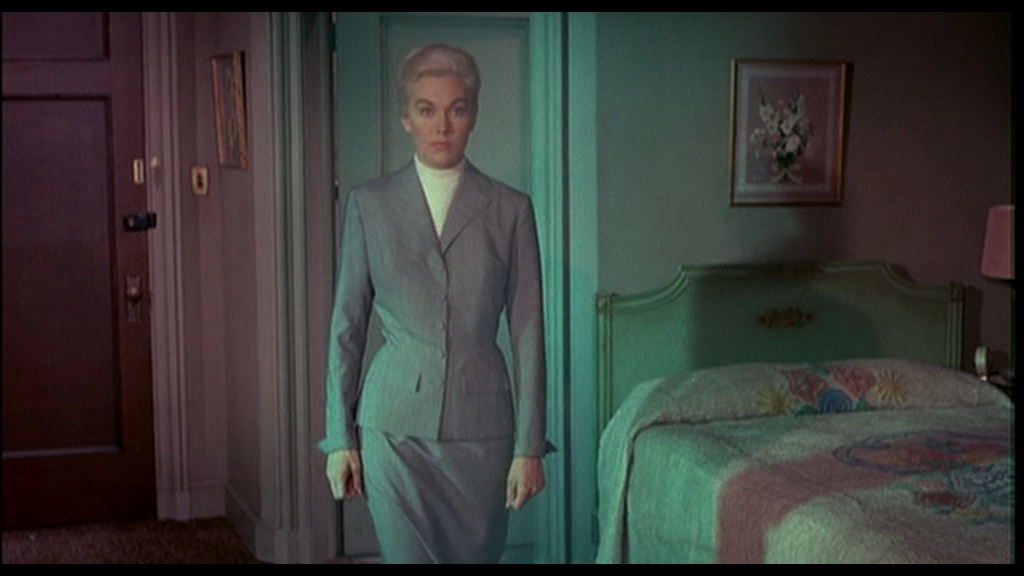
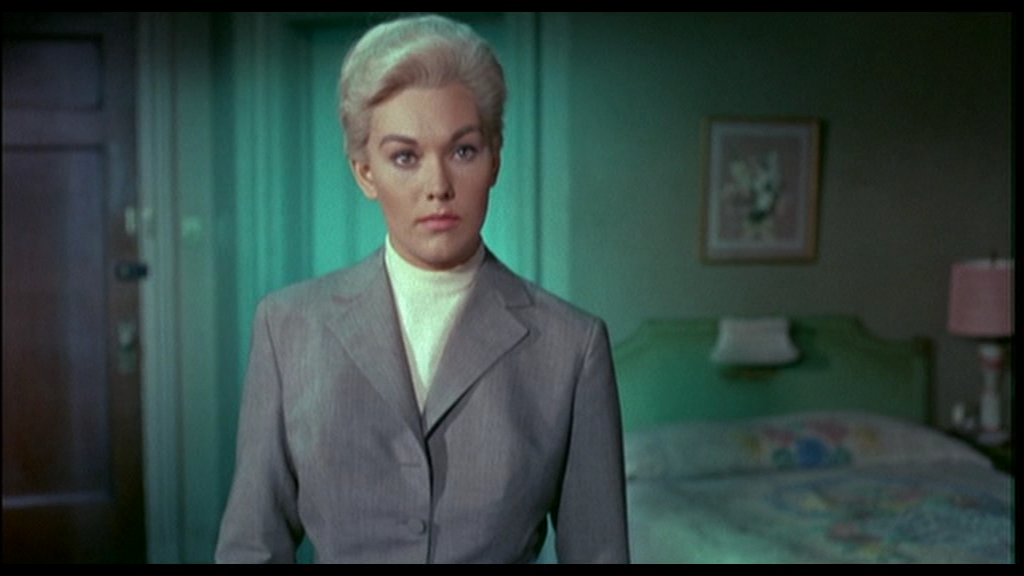
When they reach the forest, they muse over the giant redwood trees around them. Scottie explains: “their true name is Sequoia Sempervirens: always green, ever-living.” Madeleine responds: “I don’t like them… Knowing I have to die…”

With this dialogue (the only mention of the colour in the film) we are given a first idea as to what green might signify: life, specifically long, even eternal life. Madeleine’s problem is that she intermittently takes on the persona of Carlotta Valdes, a woman who killed herself many generations previously. Green could mean the reincarnation of this dead woman, a symbol of her curse, never being able to rest. Then again, Madeleine seems terrified of death – she is worried where the possession she suffers might lead her. So does she surround herself with green to ward it off? Or could it be a prelude to Madeleine’s ‘death’? Or the refusal of Scottie later to let his obsession die? There are plenty of possible interpretations along the ‘green as life’ line.

The other main line is, of course, green as jealousy. This comes to the fore in the second act of the film, after Madeleine’s ‘death’. When Scottie has recovered from his long grief, he discovers a girl who bears a close resemblance to Madeleine so he follows her to her hotel and insists his way into her life. She is Madeleine, or at least she played that part when Scottie knew her the first time round, but Scottie is as yet unaware of this. Her real name is Judy. She wears green like in her previous guise but the difference is striking and obvious. Whereas Madeleine’s greens were always weak and diluted, Judy’s green is strong and bold – it’s clear that she is the non-fictional woman.

However this is where Scottie’s obsession spirals out of control and, tragically, he sets about transforming Judy back into the Madeleine that never existed. His jealousy is squeamishly misogynist because he rejects the real woman. We, who have been behind him for an hour and a half as the protagonist, have to watch as he objectifies Judy as a kind of empty-headed doll  and then, in an insatiable craving for a dead ideal, buys her clothes identical to Madeleine’s, bleaches her hair and forces her back into character. The culmination of this effort sees ‘Madeleine’ emerge from the pale translucent light of the Hotel sign outside into a solid form.

Crossing two themes, this moment demonstrates how Scottie’s envy and obsession has seemingly brought his love back from the dead. Despite the perfect cadence in the music, we know it is a sour resolution that can only end tragically. And it does in the final scene when the couple returns to the fateful bell tower and the haunting cycles of reincarnation are finally put to bed with an actual death.

Grave of the Fireflies (1988)

I’m a bit “whatever” about anime, at least the kind exalted by the obsessives who set up appreciation societies at universities or consider a world of wide-eyed super children their perfect home, one that they refuse to leave to the detriment of their actual 3D life. A lot of it just seems reductive and sentimental where its characters’ emotions are concerned – loads of blushing, unchecked streams of disappearing tears (both lacrimation and perspiration), wild face faults. Then there’s the shorthand X-eyes (for concussion) or black eyes (for death). I know this iconography defines a style and every style has its own, but the point is I just felt anime wasn’t for me (oh, except for Pokemon and Spirited Away – but they don’t count).

I say felt because watching The Grave of the Fireflies  the other night forced me to admit that it is unfair to judge an entire country’s animation output on what – after doing a bit of research – is actually called manga. It’s a late revelation I know, but it turns out manga is the style I don’t like; anime just means Japanese animation. And Fireflies is a brilliant Japanese animation.

Set in Kobe, Japan, near the end of World War II, it chronicles the desperate struggle of two children whose mother is killed during the American air raids on the city. Seita (14) and his sister Setsuko (4) find themselves having to trade their possessions, find their own shelter and steal food, all in a bid to stay alive.

It is a story set up for the worst kind of sentimentality but, thankfully, the film earns your tears through a slow portrait of the relationship between the siblings rather than slushy dialogue and bittersweet score. Despite living in harrowing circumstances, Setsuko is as fascinated and irritated by the world as all infants are in any situation. Seita facilitates his sister’s understanding of events and looks after her health while making sure he engages her in fun and games too. They both grieve over their mother in a much more understated and telling way than simply bursting out crying. The practicality of a hand-to-mouth existence is also well portrayed without resorting to saccharine ploys for the audience’s sympathy.

Around this central relationship is built a relentless depiction of the realities of civilian life and death during the war. Dead bodies and disease are presented matter-of-factly, alongside famine, firebombing and a ubiquitous survival-of-the-fittest mentality. It is a doomy backdrop, against which the plight of the orphans looks even more fragile and precious. A small tin of fruit drops – a rare commodity in a rationed society – serves as a motif for their vulnerability. Setsuko’s happiness hangs on how many of the multi-coloured sweets remain, although like the lives of everyone around them, once they’re gone they’re gone. Fireflies, too, bind themselves to the personal story of the siblings. They light up the dark cave where the children find refuge. Though they remind Setsuko of the American B-29 bombers, the glowing insects are magical to her and their short lifespan goes hand-in-hand with her epiphany regarding the ephemeral nature of human life.

The only negative aspect of the film is actually a disguised positive (and only applies to the English Language version I saw). It is the dubbing. The dubbing itself is actually fantastic, technically. Unlike many foreign language dubs, the dialogue actually makes sense when translated into English. It is also delivered well by the voice actors and matches the characters’ movements. The foley is great too – cups on saucers, footsteps, pouring rice; all of it is close and well recorded. However, the problem is the same as with any dubbed film: replacing a film’s original language is unnecessary and completely undermines the importance of watching a culture different to your own. What makes this film the perfect demonstration of this issue is the war that the story covers and the nations that are involved; to watch horrified Japanese folk running about with American accents while being bombed by American planes is just distracting and strange. It is easily solved. Just watch it in the original language with English subtitles. That goes for any foreign film.

Director Isao Takahata affirms that Grave of the Fireflies is not an anti-war film. He’s right to an extent, the film doesn’t push a certain ideology, its characters aren’t tasked to insert lines like “isn’t this war quite bad?” into their dialogue. That’s what makes it powerful; any message one might read into the film comes purely from watching an accurate representation of the way war affects those it shouldn’t involve. If your natural reaction to that is “isn’t war quite bad?” well… then that just goes to show that this is one of the best anti-war films ever made.

Pirates of the Caribbean: What Went Wrong?

The final seconds of The Curse of the Black Pearl (aka The only POTC film that matters) see Jack Sparrow hungrily heading into the horizon having regained the Captaincy of the ship he loves – the ship that embodies the liberty that defines his character. His cooing soliloquy addressing the sunset and the sting of the title music as it cuts to black is the perfect end to the film. It leaves a whole world to the imagination. Endless speculation. Romantic.

That is until the film does unexpectedly well at the box office and a trilogy is devised to capitalise on what made it a hit.

And so the problems begin, for what bestowed such a peculiar attraction on a straightforward Disney adventure film was an unexpected thing and it being unexpected was the most attractive thing of all. This point is important.

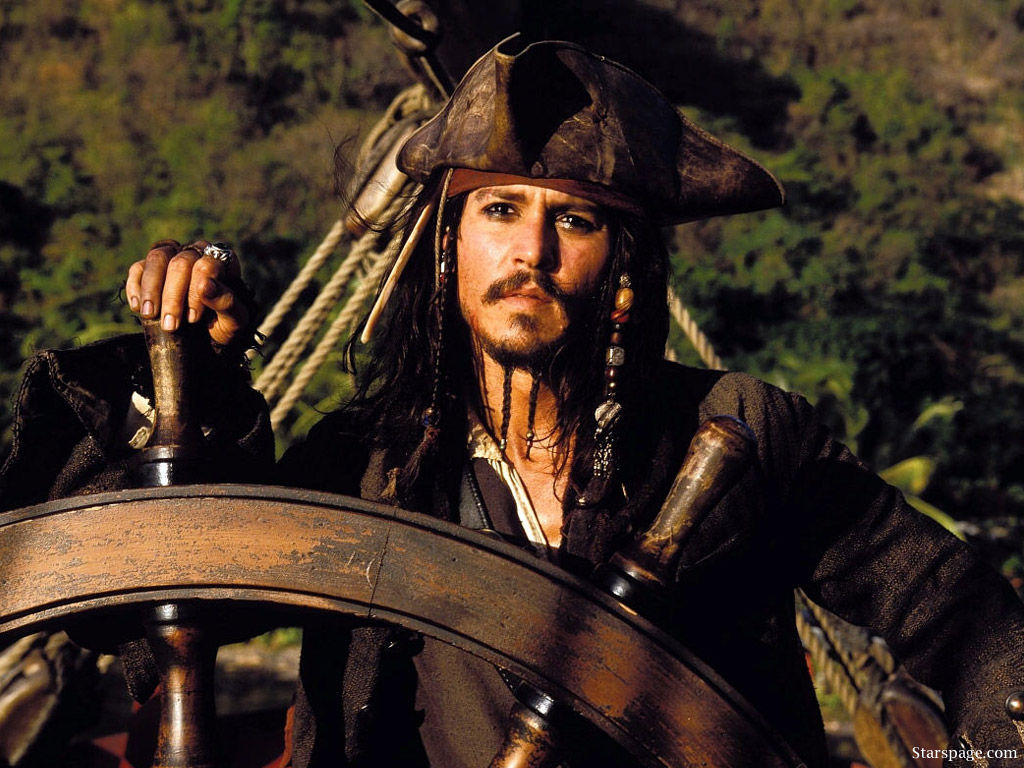
The ‘thing’ is of course Johnny Depp’s alcoholic, amoral, intellectual Captain Jack Sparrow – a creation which (if the stories are to be believed) was as much down to the actor himself as to his direction (or lack of). The confusion and concern with which executives reacted to Depp’s slurring and swaggering is well documented, as is his influence on Sparrow’s final costume and make-up.

The original film, The Curse of the Black Pearl, is a story of romance and class, a bit like your Jane Austen, only with skeletal sword-wielding opportunists. Elizabeth Swan is a privileged something; Will Turner is an orphan labourer. Can they traverse social barriers, flout Elizabeth’s arranged marriage and end up in love, even engaged, with the unlikely approval of Elizabeth’s father? Well, yes. But it’ll take an entire film to get there, helped along by the trauma of Elizabeth’s kidnap and Will’s relentless quest to rescue her from a crew of cursed pirates.

The characters of a classic narrative are in place – hero, princess, villains – and plot events can now follow their natural course. Then again, Will might need a little help along the way. He knows nothing about piracy after all and his infatuation with Miss Swan might hamper the practical side of his rescue attempt. What this story needs is a hero’s helper, or as theorists would term it, a ‘donor’. It would help if he had some connection with the bad guys; he has to lead Will to them after all… But he shouldn’t be on their side… How about a lone pirate who has fallen out of favour with the rest of the crew? Yes. Let’s call him Captain Jack Sparrow.

He is an afterthought, existing only as a facilitator in the overall quest. As director Gore Verbinski admits “The first film was a movie, and then Jack was put into it almost”. Slotted in, useful but not necessary, he has no right to steal the show.

Then he does. Because his camp gesticulation, linguistic dexterity and fluid morality are so at odds with any other character. Frankly, he doesn’t belong in a Disney film. 9 years later, there have been 3 more POTC films and another is on the way. Because of Sparrow’s profitability, Disney decided he did belong after all. And the more he belonged, the duller it became.

I’m not suggesting the film’s makers were ignorant. Verbinski is not an idiot. He does understand that what made the character work was his contrast to those who surrounded him:

They’re the straight men. They’re the kind of narrative, they’re burdened with more than Jack is. Jack gets to be more absurd and the other characters have to provide the kind of basis for the situation. (Full interview here)

They knew Jack would draw audiences back, but he needed foil to react against. The problem is, as soon as the writers clocked on to this, it became a formula. Whereas POTC 1 took itself seriously and was undermined unintentionally by a minor character, POTC 2, 3 and 4 are designed to make him the star of the show. And the whole thing isn’t fun anymore. It’s like that ‘Bedhead’ hair product. If someone wakes up and leaves the house, turning heads in the street because their hair has happened to fall into some edgy style accidentally, there’s something exciting about the coincidence. If they miss breakfast, painstakingly trying to reproduce the look in the mirror for 2 hours with a specialist serum then take the bus for fear of the wind blowing it out of place, everyone knows it. Everyone knows it and nobody is impressed.

In the spotlight, most of Sparrow’s charm begins to melt away. Some character traits are exaggerated past the point of farce, others are completely thrown out. He gets given a set of purposes (yuck), including:

1) Sate an angry Davey Jones with the souls of a hundred men
2) Vie against the East India Trading Company for a compass, Jones’ beating heart, the right to rule the waves etc.
3) Escape Davy Jones’ locker
4) Find the fountain of youth

Which burden him with concerns that contradict his carefree wanderlust. Then there’s the vocabulary. From his position as a neutral free agent, Sparrow always had a good ear for logical fallacies and contradictions. His smart exchanges exposed the hypocrisies and ignorance of those he sparred with. In later films this becomes a series of convoluted tongue twisters, self-contained and irrelevant. Brevity is the soul of wit; the indulgent ramblings of the fourth film (especially) are not.

Who to blame for ruining a good film and a magnificent character? As usual, it’s nobody that we know the name of. For it’s impossible to condemn anyone involved in its actual production. Verbinski is competent, the writing is solid, and Depp is just happy marauding in gold teeth and a dreadlocked wig. What killed the Pirates of the Caribbean was the studio’s decision to accommodate the rebel, to push him centre stage and squeeze as much money as possible out of a freak accident. Now the franchise is a monster and we’ll be lucky if it ever stops.

The Twilight Saga: Breaking Dawn Part 1 (2011)

There’s something alienating about the new Twilight film. The super sheen teen saga has been derided by the majority of critics ever since its first instalment but I went in for it; partial to the first, patient through the second and pleased with the third, something about the romance and updated vampire folklore struck a chord with me. However Breaking Dawn (part one) proved more than a let down. The glitz of its set pieces and the milking dry of any hint of love or death almost convinced me the critics were right all along.

They weren’t though, not to begin with. And it wasn’t simply because I was still a teen (just) when Twilight the First came out. In that film, the awkward unease with which Bella (Kristen Stewart) squeezes into a new school and peer group comes across effectively, probably owing as much to Stewart’s own discomfort at acting as to the actual acting itself. The obsessive calf love and ferocious desire to remain in it – and young – forever is also piercing and painful (in a good way) to watch.

What changed gradually from film to film is partly to do with the storyline. The second film in particular begins to challenge the notion that Bella and Edward’s relationship is pure, infallible and even reciprocal. Not because of the hyped introduction of werewolf Jake as a love interest but because Edward begins to treat Bella like dirt. Not only does she suffer it gladly, by the third film his behaviour has been incorporated into their relationship as if it were one of its natural ingredients. As somebody whom the books passed by, I can only hope the final film sees Bella realising her mistake sharpish and serving her blood-junkie-lover a divorce inclusive of supernatural restraining order… or else a sharpish stake to the heart.

Anyway, back to this film. I saw it in the tiny room of an inner-city multiplex, the likes of which I’d never experienced before and only seen in films like Taxi Driver. Little over thirty seats, wider than deep with audio speakers not up to much. The worst thing was the small screen/close proximity combination, like watching TV with your nose against it (except not really that bad). The aisle down the middle also meant that any hope of an optimum viewing angle were best left at the miniscule door, a porthole with less soundproofing than a greenhouse window (except not really that bad). Wow, on to the film.

A metaphor for the room it was presented in, Breaking Dawn is one of the most alienating pictures I’ve seen in a while. Things like the stretched wedding scene and all its attached glamour seem contrary to Bella’s original philosophy and create glossy barriers that prevent our engagement with her. Weren’t we supposed to identify with her as a shambling outsider, strong and honest if not a little lonely as a result? All this is forgone in favour of the sentimental romance card – painful to watch (in a bad way). This could be forgivable, or at least ignorable, if it wasn’t for the desperate argument the film seems to be having with itself. “Am I glorifying the notion of love as a slow-motion pinnacle of perfection,” it says. “Or is this character engaged in a struggle between desire, expectation and the pitfalls of loving a blood-sucking monster?” Sure you can have both at the same time, but look to the first film for an example of how delicately this needs to be handled. You can’t play both to the max and hope the audience swoons at the first then undermines the swoon with a nail-biting squirm. The swoons should come unexpected, from the depths of terror so as you’re unsure what it is about revulsion that turns so attractive. Or something.

I’m sure this thing about splitting the final instalment of a series of novels in two when adapted for the screen will become standard practice – when the previous films have been successful and the opportunity arises to eek double profit from a story’s climax, any fine capitalist would. When this decision benefitted Harry Potter and the Deathly Hallows, I was surprised. While the book certainly contains enough material for two films, I thought that the wealth of information left out of the previous films would make it hard to stretch Deathly Hallows out for four hours. Well, for whatever reason, it worked. The same cannot be said for Breaking Dawn. As I said, I haven’t read the Twilight books, so can’t have an opinion on how best to chop it up and spread it out, but the film I saw was thin and plot-starved. Simply not enough happened to merit its length. Yeah, yeah, I know some of history’s best films and plays delve into the intricacies of one single event (or less) but… Actually, that’s exactly what this film should have done. One thing happens, fine. But instead of details, instead of a raw study in the hopes and fears of each character, instead of a harrowing exploration of the possible outcomes, what fills in the gaps between A and B is more of Edward’s stern-faced platitudes and the surround sound cacophony of a gang of CG wolves arguing in human voices. I don’t know how the story ends, but I’m quite confident that the essential bits of this film could be tacked onto the beginning of the next without remotely extending its length.

Just boring really. The series has lost its life. It deserves 900 words merely to bear witness to its dullness in the hope that it might save someone else 117 minutes.

Wuthering Heights (2011)

Heathcliff. His name is the landscape and in Andrea Arnold’s adaptation, so is he – lying in muck or wind-raked grass, letting the rain beat him in the face.

Emily Brontë’s classic has rarely been treated right on small or big screens. Sold mostly as Jane Austen-style period drama (2009 TV Serial) or softened romance (1939 film), anyone smitten with the novel will tell you a film adaptation needs a strong dose of realism if it is to be anywhere near as affecting. Arnold is the first director to realise this, immediately elevating her film above all other Wuthering Heights made so far.

Apparently found on the streets of Liverpool, Heathcliff is adopted by Mr. Earnshaw and brought home to live with his family in the North Yorkshire moors. The book obscures Heathcliff’s origins although Brontë describes him as ‘gypsy’, something which no adaptation has yet taken on board. In this film, he is black, a feasible choice well followed through and one that reinforces the scorn set against him by Earnshaw’s son Hindley.

Close-ups of moths, dust, hair, beetles and clouds ground the story in earthy Yorkshire. Importantly though, this is a subjective realism – Heathcliff’s. The story follows him as if it were his story, with all the other characters appearing incidentally. This agenda is most clearly set out at the point where young Heathcliff leaves the moors after overhearing part of Cathy’s conversation with her maid. It is probably the most quoted dialogue of the book:

It would degrade me to marry Heathcliff now*; so he shall never know how I love him: and that, not because he’s handsome, Nelly, but because he’s more myself than I am. Whatever our souls are made of, his and mine are the same; and Linton’s is as different as a moonbeam from lightning, or frost from fire.

The * is the point at which the hidden Heathcliff leaves for 3 years, returning only after amassing a great fortune. He never hears the following:

My love for Linton is like the foliage in the woods: time will change it, I’m well aware, as winter changes the trees. My love for Heathcliff resembles the eternal rocks beneath: a source of little visible delight, but necessary. Nelly, I AM Heathcliff! He’s always, always in my mind.

And in this film, neither do we. The camera follows Heathcliff out into the night as Cathy’s voice trails away.

This approach works very well indeed; the intimacy we acquire with the character promises an exciting final third. This is because, although Heathcliff is obviously a quiet and stoic character, what binds you to the book is the moments when he explodes out of his shell with the kind of melodrama only an introvert can hit. Unfortunately, at the film’s climax, these moments are either too tame or unconvincing. The unremarkable acting might have been hidden better by avoiding the proclamations of love lifted from the novel. These only highlighted the lack of passion in delivery.

However, there are good performances for the majority of the film. Especially noteworthy are the child actors who play young Cathy and Heathcliff; they manage to evoke the slow-growing sensuality between the young couple believably. All too often, other adaptations give a few shots of a boy and girl playing together before the young adults take over, suddenly emerging with a fully-fledged sexuality unearned by the previous scenes. This film does it properly, building the relationship from the roots of friendship, unashamedly showing the youngsters innocently aroused by horse rides or playfights in the mud, becoming slowly and naturally acquainted with their own adolescence.

The camerawork is well considered, hand-held a lot of the time (sometimes annoyingly so) but reining it in to simple mid-shots in all the right places. The establishing shots really capture the Yorkshire moors well – the best I’ve seen. My favourites are the wide shots of the Heights during strong gales where the camera seems to wuther with the wind (I can only think they achieved this by tying it to a tree somehow). Intelligent musical choice too – not to have any. Perfect. No story deserves a blank score more. If any future adaptation does manage to keep the story intimate, the setting isolate, and the characters believable, with music underscoring events, I will be more than impressed.

Overall, this is the best Wuthering Heights film so far. It isn’t perfect – the climax needed to be far more moving – but its realism and character development is second to none, so it is definitely the one that fans of the novel should go for.

The Rum Diary (2011)

Of the reviews I have read so far, the most common criticisms levelled at The Rum Diary are: it’s not funny enough, it’s a bit dull, there isn’t a plot, it’s too long.

The mistake is to go into this film expecting Fear and Loathing in Puerto Rico. The trailer doesn’t help the matter by presenting, in order, the only drink/drug/sex related scenes that do exist, which isn’t many. Unlike Hunter S. Thompson’s later rides, this is not particularly ‘crazy’ and it’s not jam-packed with his trademark acerbic irreverence either.

This is because The Rum Diary was written when Thompson was 22. Full of ambition and idealism, he was struggling to find the unique voice that experience would later bestow. The explosion of impressionist fact/fiction ramblings known as Gonzo Journalism was still some ten years down the line. The dilemma Thompson faced at this time is summed up by a line that appears early on: “I don’t know how to write like me yet”. That’s the point I think many critics are missing.

Like Kerouac before him, Hunter S. Thompson documented his cross-country wanderings using a series of thinly veiled characters as his own alter ego. In Fear and Loathing in Las Vegas, this was Raoul Duke – a disillusioned madman on a non-stop gorge of hallucinogenic mayhem. In The Rum Diary, he is cast as a somewhat naïve journalist, Paul Kemp, newly employed by the editor of a decaying newspaper in Puerto Rico. While he has the penchant for trouble common to all of Thompson’s monikers, Kemp is young and lucid. He is not yet as purposeful and self-assured as Raoul Duke and, as such, doesn’t yet know where to channel his curiosity. The film sees him courted by greedy businessman, falling in love with one of their fiancés, and generally getting embroiled in various rum-fuelled distractions with his newspaper colleagues. Laced into the journey is a creeping epiphany about the injustice and greed of business politics which helps Kemp realise who ‘the bastards’ are and how to use his typewriter to bring them down.

Depp as Paul Kemp - 2011

Terry Gilliam was the perfect director to render Fear and Loathing for the screen, his magical realism sensibility colliding wonderfully with Thompson’s truth-bending LSD road trip. And Bruce Robinson is similarly apposite a choice to bring Thompson’s work into the realm of cinema. His 1986 film Withnail and I is one of the best ever made, deftly bringing to life the discordant friendship between an alcoholic actor and a panicky writer, both poverty-stricken and – more importantly – both outsiders, rejected by a society they despise and adore in equal measure. Depp screened Withnail for Thompson before his death and Thompson liked it. After 19 years away from the director’s chair, Robinson has made a solid return to it. As with Withnail, the directing itself isn’t especially visionary, it just tells the story well, allowing the screenplay (which he also wrote) to shine.

I haven’t read the book, but – even if The Rum Diary was simply an imagined biography of Thompson’s early life – the film does a good job of conjuring how a pre-Gonzo Thompson would behave.  The clipped mumblings of half-imagined observation that those familiar with him will recognise seep through less than 3 times throughout the film, giving the sense that his unique style is still gestating. The first time it happens is particularly striking – half an hour must have passed when finally it appears, as a non-diegetic narration over a sequence of shots showing tourists bowling. His contempt for their sheltered experience of the island is obvious. It also contains one of the rare moments of extended reality in the film, a bowling ball hurtling towards a triangle of rum bottles and smashing through in slow motion.

Depp as Raoul Duke - 1998

Johnny Depp gives as faithful a performance as he did in Fear and Loathing, perfectly toning down the eccentricity of middle-aged Thompson to the more tentative younger man. Like many, I discovered Depp in my teens, finding some sort of redemption in his portrayal of bold misfits. While taking so much from these characters at the time, it is easy to look back on the exaggerated gestures of Jack Sparrow and Willy Wonka and dismiss him as a man who pulls silly faces for children. It shouldn’t be easy because he is a brilliant actor. I think my doubts were based on his performances in Alice in Wonderland and The Tourist – two recent roles in which he didn’t deliver. The Rum Diary re-convinced me of his skill and subtlety.

For all my defending of the film, of course there are flaws. Most have mentioned the length issue, which is fair enough – it is indeed half an hour too long. And no, it doesn’t live up to Fear and Loathing in Las Vegas. But that film documents notorious Thompson, the Gonzo wrecking-ball of truth and illusion, the champion of chaos and liberty. The Rum Diary charts the unremarkable early years of a soon-to-be literary genius, which can never be as captivating as the era of the genius in bloom. The thing is, Robinson and Depp don’t try to make Fear and Loathing in Puerto Rico. What they have made is a solid document of the seeds of Gonzo Journalism, perhaps of most interest to those who already know and admire the Raoul Duke that Paul Kemp would eventually become.

The Innocents (1961)

I would be surprised if most of the tropes and techniques of the modern psychological horror film couldn’t be traced back to The Innocents.

Based on The Turn of the Screw by Henry James, it follows young Victorian governess Miss Giddens (Deborah Kerr) who is put in charge of two young children at a large country estate with only the housekeeper for adult company. After witnessing several apparitions, Miss Giddens becomes convinced that the odd-behaving children are possessed by the spirits of the mansion’s previous inhabitants.

The film is shot in black and white using the wide cinemascope format which allows cinematographer Freddie Francis to add expression with hard lighting and deep focus. Together with the sound design, these are the foundations for the chilling set pieces of the film.

One such scene is the apparition of the ghost of Peter Quint, former valet of the children’s uncle, during a game of hide-and-seek. Miss Giddens, in the foreground, is looking for a hiding place when the figure appears suddenly at the window behind her.

What makes it so striking is how clear and in focus Quint is; both foreground and background are equally sharp. Also, due to the hard light coming in from the left near the window, he seems to creep in out of nowhere. Despite how rudimentary this technique seems today, the effect is still pretty unsettling. I can only imagine that this kind of thing froze the blood of audiences in the ’60s.

Soon after, we get this close-up.

The light from the left I mentioned now casts hard shadows across the face – standard horror effect stuff. It works even better on an actor whose features are the most sharp and angular of anyone else in the film. Also of note are those sparkling points in the eyes. They remind me of a close-up in the first Lord of the Rings film on Galadriel’s starry eyes, an effect created by suspending multiple Christmas lights opposite the subject’s face. I guess The Innocents achieved this in a similar fashion, maybe with fewer (and brighter, and larger) bulbs. Anyway, because the light for the face is side-on and close to the window, when the figure shrinks back into the shadows, those eye-glints are the last things to go – brilliantly haunting. As is the sound at this point which contains Quint’s slow, calm breathing and Miss Giddens’ sharp, broken gasps.

As spooky as these apparitions are, the film (like the original novella) questions the reliability of Miss Giddens’ perception. Are the children really possessed and is the mansion actually haunted? Or is all this supernatural phenomenon an imagination of the governess? Has she a repressed sexuality that gives rise to delusional visions and wild assumptions? Ultimately, we never find out but the excellent screenplay drops tiny hints in both directions.

Supporting the Freudian interpretation are discreet words slipped in to Miss Giddens’ dialogue now and then which seem to reveal an obsession with corruption and depravity. Like describing Quints ghost as ‘Handsome and obscene’ or the children’s behaviour as ‘whispery and indecent’. Her fascination with secrets extends to questioning the housekeeper about the dead lovers and their indiscreet behaviour and profane language. It’s very subtle and it is clear that Miss Giddens thinks she has the children’s best interests at heart but she over protests on this point and others. When explaining how she intends to visit their uncle and confront him, she thinks aloud: ‘he’ll think I’m insane or that it’s some stupid trick to get him to notice me’. Why is there any reason for her to suspect that? Unless it touches on unconscious feelings, unconscious reasons behind the hallucinations.

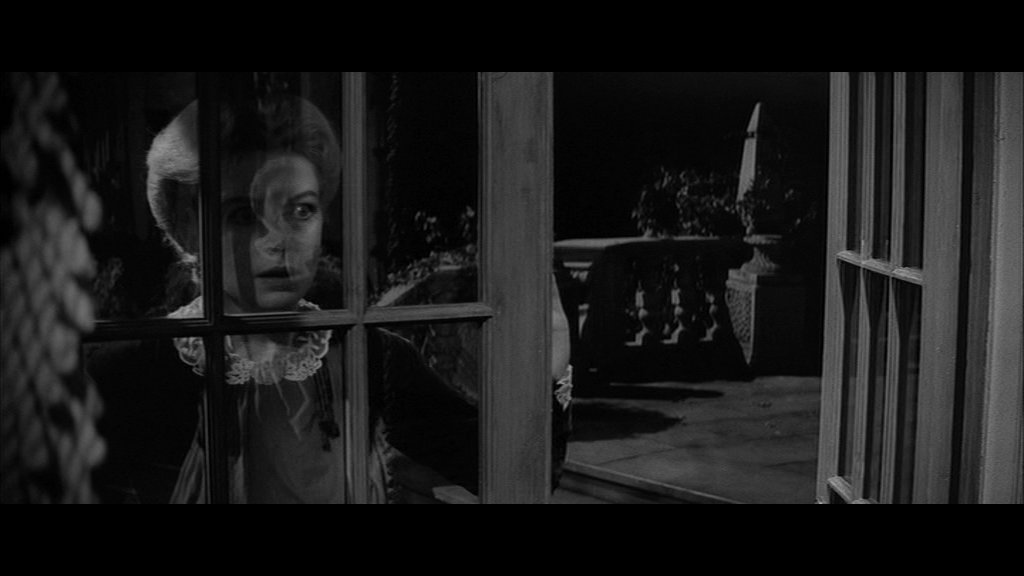
The editing does a good job with visual trickery, playing with the idea of seeing things that aren’t there. The portrait of Quint is laid over a shot of Miss Giddens having troubled sleep, suggesting maybe her daytime visions are just extensions of nightmares. There’s also a great shot just after the first ghost’s appearance when the housekeeper approaches the window to ask what the matter is; she enters the scene as a reflection, laid over Miss Giddens. This reminds us that the real world contains optical illusions and encourages us to question the reliability of our main character’s point of view.

Not that the governess is always under our investigation. The child actors do such a good job being creepy that for a large part (especially on the first viewing) of the film, I was sold on the idea of their possession. The girl, Flora, seems to have repressed memories revolving around the dead couple and a morose lullaby.

The boy, Miles, talks with a kind of smug experience and takes glee in insouciantly manipulating Miss Giddens’ concern for him. The sense that he may house the spirit of an older man comes to a head in a scene where he kisses her goodnight full on the mouth, stunning her into holding the position for a few seconds before drawing away.

Like all the great psychological horrors it helped lay the foundations for, The Innocents explores the twisted nature of human perception and the mind-horror that can ensue. That it achieves its atmosphere through lighting, dialogue and sound editing makes it as impressionistic as the literature it was inspired by.

Let the Right One In (2008)

Photo by Michael Taylor

ODEON, Huddersfield – As charmless, expensive and bland as any links in that giant chain. Yet most Tuesday evenings last winter found me trekking the 1.7 miles out of town past looming gasworks and derelict mills towards the single sacred multiplex in the HD postal area.

On one of the coldest nights of my life, the ‘Film Fan Tuesday’ feature was Let the Right One In. Caught between impossible black-iced pavement and sodium streetlights, I passed no one, finally reaching the cinema just in time. I walked in and sat down as the snowflakes of the first shot invaded the screen. What followed served to laden with doom thoughts of the walk home; never before had I crossed the threshold from pedestrian to film viewer and found the atmosphere on both sides so alike.

Set in a Swedish suburb so dark and cold that barely anyone populates the evening landscapes, the film centres on 12-year-old Oskar, a victim of ritual schoolyard bullying who becomes close friends with Eli, a child vampire.

Vampire characters usually reside comfortably within the realm of fantasy horror, giving filmmakers the opportunity to explore melodramatic folklore and graphic violence, inflicting thrills and chills on a suspecting audience. Let the Right One In ignores that potential in favour of a more ‘social realism’ style of storytelling. Writer John Ajvide Lindqvist and director Tomas Alfredson are concerned with themes such as cruelty, loyalty and innocence as seen from the perspective of a pre-adolescent boy. At its heart, the film is a tender love story. There just happens to be a vampire involved.

Cinematography is key in creating the sense of intimacy needed. Soft light reduces shadow in many scenes, leaving room for Alfredson’s expressive shallow focus to draw the eye over wide shots to different points of interest over time. Slow camera movement gives us this time, enhancing the realism whilst playing with what we are allowed to see. None of these are obvious choices for a film that leans into the horror genre but they are what give it character and style.

The choreography of hands cannot be underestimated either. A constant visual motif throughout, they are used as a reliable means of discerning Oskar and Eli’s emotions.

As Alfredson explains ‘it’s very hard to lie with the hands’. The first time Eli touches Oskar is to take hold of his hand while insisting he hit back against the bullies. Later they communicate through the wall that separates their bedrooms using morse code to tap out messages.

As a powerful supernatural being, Eli offers Oskar strength and support. In return, Oskar gives Eli the chance to experience the things her condition has stolen from her – childhood and innocent love. They bond over a Rubik’s Cube, a puzzle that confuses Eli until Oskar tells her ‘Just twist it’ – an ironic instruction given the neck that Eli has broken in the previous scene to score her latest meal.

Perhaps the most successful use of the vampiric component of the story is its juxtaposition with the hard reality of bullying. While Eli is clearly tortured by her thirst for blood and the violence it necessitates (sobbing after each kill), Oskar’s tormentors choose to make his life a living freezing hell. Listening to the director/writer’s commentary on the DVD, it is clear whose evils the makers are more prone to forgive.

So considering the sympathetic portrayal of the film’s ‘monster’ and the plot’s revolution around love rather than gore, why was I so hyper-aware on my walk back through the night after leaving the cinema? Well, the weather certainly helped. Alfredson’s evocation of dark Scandinavian nights becomes easy to appreciate during Britain’s coldest winter for 30 years. Too cold for most people to bother going out in, it is easy to believe Eli and her helper Hakan can commit their gruesome deeds unnoticed on the fringes of populated areas. And it’s the fringes you have to navigate when your hilly northern town plonks its only cinema down in a location convenient only for cars to reach. It’s not ideal but, in the context of this particular experience, it’s perfect.

Morvern Callar (2002)

Why isn’t she sobbing? Why hasn’t she phoned the police? Morvern Callar (Samantha Morton) has found her boyfriend lying dead in the soft pulse of the Christmas tree lights, suicide note written on the computer screen. She opens the presents he left her, then goes out for a night of ecstatic parties with best friend, Lanna.

Morvern is certainly an unusual character. Largely melancholic with inexplicable moments of impulsiveness and a muted lack of fear that leads to her and Lanna disorientated in rural Spain, one can imagine her behaviour falling within the definition of some personality disorder or other. But this isn’t mentioned and it doesn’t matter. What is important is that, through Samantha Morton’s masterful portrayal, we begin to spot a consistency that leads to a deep understanding of her character even if her decisions don’t make clear sense.

Lynne Ramsay directs with sensitivity and precision. Keeping cuts down to a minimum results in long-durational shots which allow a natural flourishing of realism. It makes room for the audience to do the interpreting instead of letting the editing do it for them.

While there is a general absence of overt grief from Morvern and barely any mention of her dead boyfriend, the whole film is about her adjustment to life without him. Her reaction seems to be to gently absorb his life into her own. This includes replacing his name for hers on the title page of his recently finished novel and sending the manuscript off to publishers. A highlight is the moment she paints her nails scarlet before going out. Over her shoulder, the camera loses focus and her hand briefly resembles the bloodied ones of the man lying in the next room.

Among the presents left for her are a Walkman and a cassette tape of music. At first impatiently fast-forwarding through tracks she doesn’t like, the evocative mixture of 60’s pop and cold electronica becomes the soundtrack to her days – walking to work as a shelf-stacker, wandering about the Scottish hills and even burying the body. One of the most beautiful images of the film is Morvern wandering through a packed nightclub, earphones in, listening to The Mamas and Papas while the ravers around her dance to a different tune.

We can never be clear whether her blank-faced hedonism is a form of mourning or if his death has liberated her. There are clues that point in both directions, making the film intriguing and baffling. Ramsay and Morton’s biggest achievement is how much of a detailed impression of Morvern their audience comes away with whilst still being none the wiser about her past or motives.