
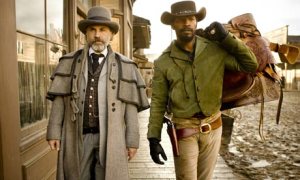
 Quentin Tarantino’s return to form is, like all of his best work, a showcase of tributes to his favourite exploitation films all squished together to the point of bloodbath. The outrageous violence of its set pieces is choreographed to perfection and is topped only by the mellifluous ear candy of the movie’s dialogue.
Let’s first be clear, there is no controversy here. Django Unchained is neither as offensive as Spike Lee imagines it would be (were he to actually give it a watch) nor is it as thought provoking as Tarantino himself pretends. The subject of slavery is volatile of course and a filmmaker who really wanted to ‘raise issues’ would have to tread extremely carefully. But this isn’t a film about slavery by Quentin Tarantino, it is a Tarantino film with some slaves in it.
The cast is nothing short of superb. Christoph Waltz was made to deliver the magniloquent exactitude of Tarantino’s dialogue and does it in a dandyish devil-may-care manner that never contradicts the menace of his character, Dr. King Schultz – a German ex-dentist bounty hunter who abhors slavery and sets Django free. Django himself is played by Jamie Foxx in a brooding and controlled manner which perfectly compliments his co-star. As the film progresses, Schultz betrays a burden of care for Django, who becomes more and more cocky as he adjusts to freedom. The interaction between the two as their performances shift is fascinating to watch.
 Also fascinating is Calvin Candie, owner of the infamous Candieland plantation, who Leonardo DiCaprio portrays with a subcutaneous threat to match that of Schultz. The tension in the air as Django and Schultz slowly acquaint themselves with Candie is delightful. Under the guise of Mandingo Trainers (‘mandingos’ are slaves bred to fight each other to the death) they attempt to rescue Django’s wife, Broomhilda (Kerry Washington) from Candieland with a predictably messy climactic outcome.
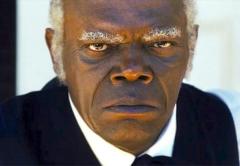
The ultimate show-stealer is Samuel L. Jackson who plays the elderly servant Stephen, Candie’s (sort of) Head of the House Slaves. Stephen is a masterpiece of a character, unconditionally loyal to his master but exhibiting the cheek of Django and the irritability of an old man who Candie has allowed to get away with years of surliness for the sheer fun of his outbursts. Jackson brings an unsettling elderly shake to his character and the slow-spreading contortions of face as Stephen becomes suspicious of Candie’s guests is physical acting at its finest.
If there is one element of the film that can be written about seriously in terms of racial politics then it is Stephen, it is the psychology of a man enthralled by his master, a man who truly believes himself inferior to a white man.
Django Unchained is directed with the care and consideration taken to framing its subjects that the old Spaghetti Westerns took. Apart for the sequences of violence, camera movement is generally slow and often holds on shots that could pass as paintings as far as mise en scène goes – moments such as: the chain gang far off in the distance bookended by two nearby rocks at the screen’s left/right extremities, two horsemen riding as shadows into the sunset, a whole town pointing 100 shot guns at the camera and DiCaprio’s Candie grinning full-screen with smoke seeping through his teeth. Juxtaposed with this style is the occasional crash zoom, which nods fondly to old westerns, and induced grins around the cinema.
 The one gripe I have with the film is its lack of discipline. Quentin Tarantino is an auteur; of that there is no doubt. Give him a camera and some money and he’ll have a ball. But while that might be unbridled joy for him, his films suffer if nobody reins him in. Take his interviews in which he often makes fantastic points and examines cinematic issues in very interesting detail but which can quickly topple into ridiculous self-important ramblings if the interviewer lacks the bravery and awareness to contain his answers and switch the area of conversation when required.
My favourite thing about Tarantino is those absurd moments where captious characters tie themselves up in semantics trying to explain why a Ku Klux Klan mask isn’t practical when riding a horse or pondering the layers of meaning behind a foot massage. However, these can only work within the context of a story moving forward. Occasionally, Django Unchained loses its momentum. Whether this is because Tarantino is missing the skills of his late long-time editor Sally Menke or because he works best with a writing partner, I don’t know but it definitely looks as if the critical eyes of sterner collaborators could be vital in helping maintain the focus of his work as he moves into the later stages of his career.
 Jon Bates Writes